

We covered the basics of the Carbon Border Adjustment Mechanism (CBAM) in our first blog, where we explained why it was created, which industries it currently applies to, and why companies outside the European Union (EU) should pay attention.
In this article, we're covering what businesses should do after determining that a product they manufacture or supply is covered by CBAM. With the first annual CBAM declaration due September 30, 2027, the embedded emissions reported for CBAM-covered goods will be based on activity occurring in 2026.
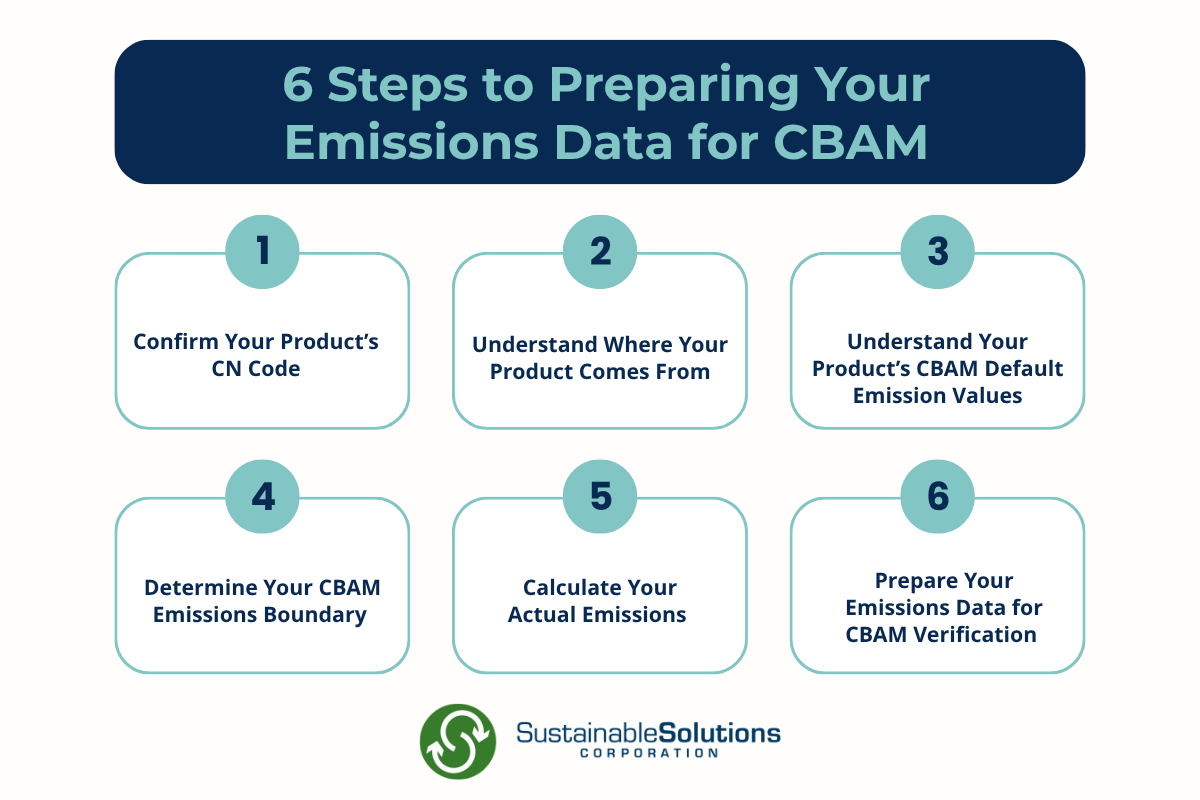
If you're navigating CBAM requirements, following these six steps can help establish a path toward compliance:
Confirm Your Product's CN Code
Understand Where Your Product Comes From
Understand Your Product’s CBAM Default Emissions Values
Determine Your CBAM Emissions Boundary
Calculate Your Actual Emissions
Prepare Your Emissions Data for CBAM Verification
Step 1: Confirm Your Product’s CN Code
The first step is confirming which products are subject to CBAM.
Products entering the EU are classified using Combined Nomenclature (CN) codes. CBAM applies to specified CN codes within covered sectors, making accurate product classification an important starting point.
Companies should review the products they manufacture or supply and confirm the applicable CN codes against the products covered by CBAM.
This establishes an important foundation for the steps that follow. Different products can have different emissions profiles and calculation requirements, so businesses first need to understand exactly what they are working with.
Step 2: Understand Where Your Product Comes From
Once you've identified the product, the next question is: Where was it produced?
Global supply chains can make the answer more complicated. A company could manufacture a product itself and sell it directly into the EU. In other situations, distributors, warehouses, importers, or other intermediaries could source the same material from several locations.
Understanding the origin of a product is important because CBAM default emissions values can vary based on the product and where it was produced.
For businesses, this means you need visibility into the supply chain behind your product.
Step 3: Understand CBAM Default Emissions Values
Once the product and its origin have been established, companies can identify the applicable default emissions values. These values can be found on the EU's CBAM Definitive Regime page.
With the first annual CBAM declaration due in September 2027, organizations that cannot provide verified actual emissions data will need to rely on conservative default values, which may result in higher CBAM costs.
As stated in the EU’s CBAM Questions & Answers, “during the definitive period, authorized CBAM declarants can use default values for CBAM goods other than electricity when verified actual embedded emissions data are not available”. These default values include a percentage mark-up designed to prevent embedded emissions from being underestimated. The mark-up is 10% in 2026, 20% in 2027, and 30% beginning in 2028, with a lower mark-up applying to the fertilizer sector.
The European Commission notes that, in most cases, using actual values should be more advantageous for authorized CBAM declarants when those values are available.
Because default values can differ based on the product and country of origin, two otherwise similar products can have different default emissions profiles depending on where they were manufactured. But a default value doesn't necessarily tell you how your specific operation performs. Your actual emissions could be lower than the applicable default. They could also be higher.
Understanding your own emissions gives your organization greater insight into how its operations compare with the applicable default and whether there is a business case for reducing emissions.
Step 4: Determine Your CBAM Emissions Boundary
Before calculating actual emissions, companies need to understand which parts of the production process are included.
CBAM embedded emissions should not be treated as a complete product carbon footprint. A traditional product carbon footprint considers emissions across a broader lifecycle, which can include raw material extraction, transportation, manufacturing, and other lifecycle stages. CBAM focuses on specific carbon-intensive production processes associated with covered products.
Take steel as an example. The lifecycle of a steel product typically begins with mining raw materials, transporting those materials, producing the steel, processing it into rods, beams, or sheets, and eventually manufacturing those materials into a finished product.
However, under CBAM, the relevant emissions boundary does not always include every one of those stages. The steelmaking process itself is particularly carbon intensive. Significant energy is required to heat and process the materials, and the chemistry of the production process can also generate carbon dioxide. Those carbon-intensive production activities are central to understanding the product's embedded emissions.
For a company farther downstream, however, the situation can look different.
A manufacturer could purchase steel rods or sheets from a supplier and transform them into another product. Depending on the covered product and applicable boundary, the relevant emissions can occur primarily at the supplier's facility rather than the downstream manufacturer's own facility.
This is why companies need to ask:
Where are we in the product's supply chain?
Which production processes are relevant to our CBAM calculation?
The answer can involve the company's own operations, its supplier's operations, or a combination of the two.
Step 5: Calculate Your Actual Emissions
Once the appropriate boundary is understood, companies can begin determining the actual emissions associated with production. For a supplier producing the carbon-intensive material, this starts with understanding the Scope 1 and Scope 2 emissions associated with the relevant site or production area.
The calculation can require information such as:
Fuels consumed during production, such as natural gas, coal, or propane
Energy used by the relevant operation
Applicable emission factors used to convert energy and fuel consumption into greenhouse gas emissions
Process-related carbon dioxide emissions
Total production during the applicable period
The company can then relate the relevant emissions to its production, resulting in an emissions intensity for the product—for example, an amount of CO₂ emissions per ton of product.
The exact calculation can vary depending on the facility, production process, and covered product, which makes understanding the applicable methodology and system boundary important.
Step 6: Prepare Your Emissions Data for CBAM Verification
For organizations to declare their actual embedded emissions rather than rely on default values, their emissions data must be accurate and verifiable according to the applicable CBAM requirements.
As CBAM moves toward emissions verification, organizations should maintain consistent documentation supporting the energy, production, and emissions information used in their calculations.
If an allocation is used, for example, there should be data and a defensible methodology supporting how that allocation was determined. Companies should avoid relying on unsupported estimates that cannot be substantiated later.
Preparing this documentation alongside the calculation can make it easier to address verification requirements rather than trying to reconstruct the supporting information after the fact.
The Path to Preparing Your Emissions Data for CBAM
For companies with CBAM-covered products, the path forward begins with understanding what you're producing and where the associated emissions occur.
Start by confirming your CN codes and understanding where your products are sourced. Identify the applicable default emissions information, determine the relevant CBAM emissions boundary, and evaluate whether you have the data needed to calculate actual emissions.
Most importantly, don't treat the emissions calculation as just another number to report.
Reliable emissions data can help your organization understand how its products compare against default values, identify potential carbon-related business exposure, and determine where emissions-reduction opportunities exist. If actual embedded emissions are lower than the applicable default values, using verified actual emissions can also reduce CBAM costs.
Sustainable Solutions Corporation (SSC) supports companies in establishing the greenhouse gas emissions data needed for CBAM reporting and verification. Our team supports Scope 1 and Scope 2 greenhouse gas accounting and helps organizations evaluate their operations, identify opportunities for improvement, and develop strategies for reducing emissions.
Whether you're just beginning to understand your emissions or looking for opportunities to improve an existing carbon profile, knowing where you stand is the first step toward determining what comes next.
Looking for Further Guidance on CBAM Emissions Reporting?
For organizations looking to better understand the next steps, watch our on-demand webinar, Don’t Wait for the CBAM Deadline: Prepare Your Carbon Data Now for Verification, for a discussion designed to help manufacturers, exporters, suppliers, and EU importers understand what they should be doing now to prepare for CBAM reporting and verification.
Don't wait until reporting deadlines approach to identify gaps in your emissions data. Start preparing now to understand your data, establish defensible methodologies, and prepare for CBAM verification.
Frequently Asked Questions
What emissions data do I need for CBAM reporting?
For CBAM reporting, organizations need to report specific greenhouse gas emissions associated with the carbon-intensive production processes applicable to their covered goods. Embedded emissions generally include relevant Scope 1 CO₂ emissions and Scope 2 emissions associated with electricity consumption.
Embedded emissions should not be treated as a product carbon footprint because CBAM does not consider all emissions across a product’s lifecycle. Instead, the calculation focuses on emissions from the applicable production processes and, where relevant, embedded emissions associated with precursor materials.
As explained in Section 4.2, page 23, of the European Commission document:
“For the purpose of determining CBAM embedded emissions at a product level, the starting point are emissions of an installation. The installation’s emissions are split (‘attributed’) to emissions of its production processes. Then any relevant embedded emissions of precursor materials are added, and the result is divided by the activity level of each production process, for products under the same CN code and to which the same functional unit applies, thereby resulting in ‘specific embedded emissions’ (SEE) of the goods from the production process.”
Can I use default emissions values for CBAM?
Yes. Under the definitive CBAM regime, authorized CBAM declarants can use default values for CBAM goods other than electricity when verified actual embedded emissions data are not available.
However, CBAM default values include a mark-up designed to prevent embedded emissions from being underestimated. This means organizations should understand how their actual emissions compare with the applicable default value. If verified actual emissions are lower, reporting actual emissions can provide a financial advantage over relying on the default value.
Do I need emissions data from my suppliers for CBAM?
It depends on where your organization sits within the product’s value chain and which production processes are relevant to the CBAM calculation.
If your company purchases a covered material or relevant precursor from another manufacturer, emissions from that supplier’s production process can be part of the embedded emissions calculation. This makes it important to understand both your CBAM emissions boundary and where the necessary emissions data originate within your supply chain.
Do CBAM emissions data need to be verified?
Yes. When actual embedded emissions are used for CBAM reporting, the applicable emissions data need to meet CBAM verification requirements.
Organizations should maintain documentation that supports the energy, production, emissions, and allocation data used in their calculations. Establishing defensible methodologies and maintaining supporting records as the data are collected can help organizations prepare for verification rather than reconstructing the information later.
Meet the Expert

Cara Vought, LCACP
Senior Technical Consultant
Cara has over 15 years of experience in product stewardship and corporate sustainability strategy. She specializes in developing life cycle assessments (LCAs) and product carbon footprints, conducting independent LCA reviews to ISO standards, supporting industry associations and collaboratives in program development, and facilitating audits for sustainable manufacturing initiatives and LEED certifications.
She earned a Bachelor of Science in Chemical Engineering from the University of Delaware, with minors in Sustainable Energy Technology and Environmental Engineering. Cara also served as an adjunct professor at Jefferson University, where she taught architecture and design students how to think about materials sustainably. She believes that sustainability is an ever-evolving field that requires continuous learning and adaptation. With a passion for education, she works closely with SSC’s clients to help them expand their knowledge and integrate sustainability into their business practices.