

The Carbon Border Adjustment Mechanism (CBAM) represents a shift in the relationship between climate policy and global commerce. CBAM is designed to address the carbon emissions associated with certain carbon-intensive goods imported into the European Union (EU). While CBAM is an EU regulation, its effects extend beyond Europe. Manufacturers and suppliers in the United States and other countries may be affected when their products—or products containing the materials they produce—enter the European market.
What Is the Carbon Border Adjustment Mechanism?
At its core, CBAM places a carbon price on certain carbon-intensive goods imported into the EU. The goal is to create a more comparable carbon cost between covered products manufactured within Europe and those produced elsewhere and imported into the European market.
To understand why the EU developed this mechanism, it helps to understand a concept known as carbon leakage.
What Is Carbon Leakage?
European manufacturers in certain carbon-intensive industries already face costs associated with their greenhouse gas emissions. As environmental requirements become more stringent, producing goods within Europe can become more expensive for higher-emitting operations.
This creates a potential unintended consequence: rather than investing in lower-emission production, a company could move carbon-intensive manufacturing to a country with less stringent climate policies. Alternatively, European businesses could purchase lower-cost products from manufacturers operating in countries where carbon emissions are not subject to comparable costs.
From a global climate perspective, neither scenario necessarily solves the underlying problem. The emissions are simply moving from one country to another, which is a concept known as carbon leakage.
CBAM is intended to reduce the risk of carbon leakage by applying carbon-related requirements to certain goods imported into the EU.
How Does the European Union Price Carbon?
CBAM is closely connected to the EU Emissions Trading System (EU ETS), the EU's existing carbon market.
Under the EU ETS, covered industrial facilities must account for their greenhouse gas emissions through emissions allowances. These allowances have a market value and can be traded, creating a financial incentive for companies to reduce their emissions.
For example, a facility that lowers its emissions can reduce its exposure to carbon costs. A higher-emitting facility, on the other hand, may need additional allowances, increasing the financial cost associated with its emissions.
The system's goal is to encourage companies to invest in lower-emission technologies, process improvements, and energy efficiency to reduce their overall emissions.
However, the EU ETS creates an important trade question: What happens when a comparable product is manufactured outside of Europe, where the producer does not face the same carbon costs?
This is where CBAM comes into play. CBAM extends the concept of carbon pricing to certain imported goods so that moving production outside the EU does not automatically eliminate the carbon-related cost associated with manufacturing those products.
Which Products Are Covered by CBAM?
Currently, CBAM focuses on several carbon-intensive sectors, including:
Iron and steel
Aluminum
Cement
Fertilizers
Electricity
Hydrogen
In these industries, emissions result not only from the energy needed to operate manufacturing equipment but also from the chemical reactions inherent in the production process.
Steel and cement are good examples. Even as manufacturers transition to cleaner energy sources, addressing emissions from the underlying industrial processes can require changes in technology and production methods.
To determine which products are covered by CBAM, products entering the EU are classified using Combined Nomenclature (CN) codes, a standardized system used to classify goods for customs purposes. CBAM applies to specified CN codes within the covered sectors.
Therefore, manufacturers and exporters should verify their products' CN codes to determine whether CBAM applies to the goods they sell into the EU.
How Does CBAM Work?
At a high level, CBAM connects the amount of covered goods entering the EU with the greenhouse gas emissions embedded in their production and the carbon price associated with those emissions.
The process begins with determining whether an imported product falls within CBAM's scope based on its CN code.
From there, the quantity of covered goods entering the EU must be identified, along with the embedded emissions associated with producing those goods.
Those emissions are important because CBAM is designed to reflect the carbon cost that would apply if the product were produced under the EU's carbon-pricing system. Where an eligible carbon price has already been effectively paid in the country of origin, that may also be taken into account under the applicable CBAM rules.
In simplified terms, the process looks like this:
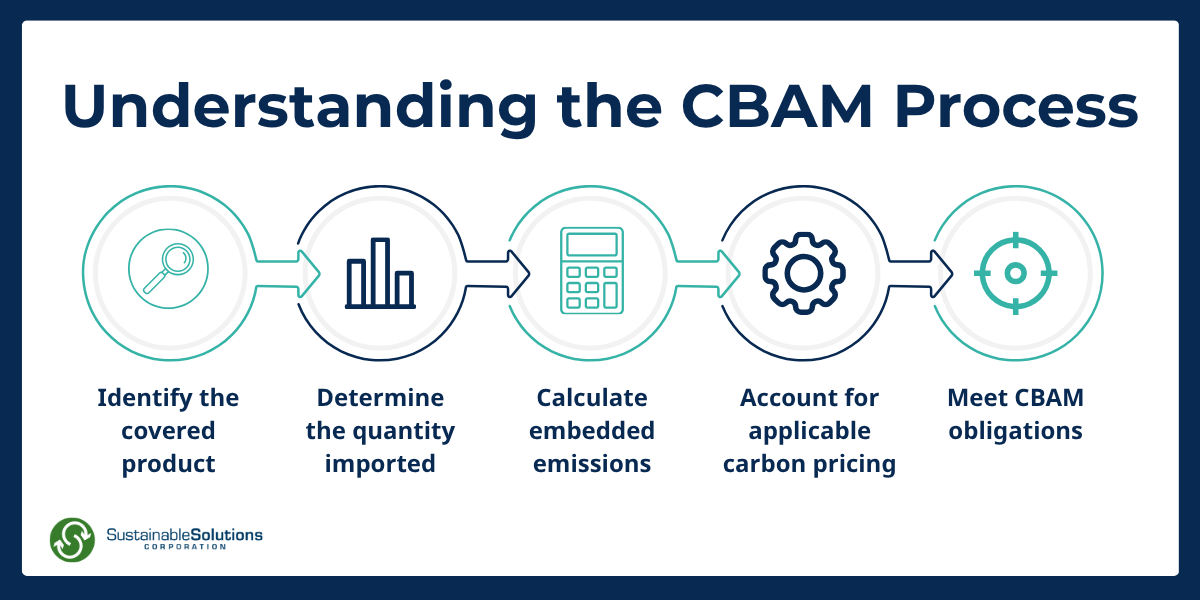
Identify the covered product → Determine the quantity imported → Calculate embedded emissions → Account for applicable carbon pricing → Meet CBAM obligations
While the EU importer generally sits at the center of the CBAM compliance process, manufacturers and suppliers outside Europe can play an important role because they may hold the emissions information needed to complete those calculations.
Why Should Companies Outside the EU Pay Attention to CBAM?
It can be easy for a U.S. manufacturer to look at CBAM and assume that an EU regulation is primarily a concern for European companies.
In practice, CBAM can reach much farther into the supply chain. An EU importer may need emissions information from the facility that manufactured the covered product. That means European customers may turn to their suppliers outside the EU for detailed information about how products were manufactured and the greenhouse gas emissions associated with their production.
A company therefore can encounter CBAM even when it is not directly responsible for importing the product into Europe.
This makes CBAM a supply chain and international trade consideration for companies selling carbon-intensive products into the European market.
What Should Businesses Be Doing to Prepare for CBAM?
Companies with products or materials entering the EU should begin by determining if they have exposure to CBAM.
A useful starting point is to review products sold into Europe and determine their applicable CN codes. Companies should then verify whether those codes fall within the scope of CBAM and identify where covered goods enter the European market.
From there, businesses should understand their role in the supply chain. The following questions can guide this process:
Who is importing the product?
Who is responsible for the applicable CBAM requirements?
What information is the importer requesting from its suppliers?
Companies should also begin evaluating whether they have access to the emissions information that are required. Organizations with established greenhouse gas inventories may already have valuable data available, while others will need to develop new processes for calculating and documenting emissions.
Start Preparing Your Emissions Data Now
The first annual CBAM declaration is due in September 2027. However, the emissions data needed to support it are being generated now. For companies that need to calculate or provide emissions data for CBAM, establishing a reliable greenhouse gas inventory is an important part of that preparation. Sustainable Solutions Corporation (SSC) assists companies with greenhouse gas emissions accounting, including Scope 1 and Scope 2 emissions calculations, and can help organizations understand and address gaps in their emissions data.
If your organization is ready to begin evaluating its greenhouse gas emissions and CBAM data needs, connect with SSC to discuss how we can help.
Preparing for CBAM Emissions Verification?
For organizations looking to better understand the next steps, watch our on-demand webinar, Don’t Wait for the CBAM Deadline: Prepare Your Carbon Data Now for Verification, for a discussion designed to help manufacturers, exporters, suppliers, and EU importers understand what they should be doing now to prepare for CBAM reporting and verification.
Meet the Expert
Cara Vought, LCACP
Senior Technical Consultant

Cara has over 15 years of experience in product stewardship and corporate sustainability strategy. She specializes in developing life cycle assessments (LCAs) and product carbon footprints, conducting independent LCA reviews to ISO standards, supporting industry associations and collaboratives in program development, and facilitating audits for sustainable manufacturing initiatives and LEED certifications.
She earned a Bachelor of Science in Chemical Engineering from the University of Delaware, with minors in Sustainable Energy Technology and Environmental Engineering. Cara also served as an adjunct professor at Jefferson University, where she taught architecture and design students how to think about materials sustainably. She believes that sustainability is an ever-evolving field that requires continuous learning and adaptation. With a passion for education, she works closely with SSC’s clients to help them expand their knowledge and integrate sustainability into their business practices.