
Extended Producer Responsibility (EPR) introduces new considerations around circularity and environmental impact. Because packaging decisions are often made before EPR fees are assessed, companies may miss opportunities to reduce future costs once products have already reached the market.
At the same time, there is no one-size-fits-all approach to developing packaging that complies with EPR regulations while meeting sustainability goals. Each industry has unique needs, and many products must meet specific requirements related to food safety, sterilization, durability, or regulatory compliance.
So how can companies develop packaging that supports EPR requirements while also balancing cost, recyclability, environmental impact, and performance?
The answer starts with data-driven tools that help teams evaluate packaging decisions earlier in the product development process, when the greatest opportunities for optimization and cost reduction still exist.
How to Incorporate Sustainability Before Packaging Is Designed
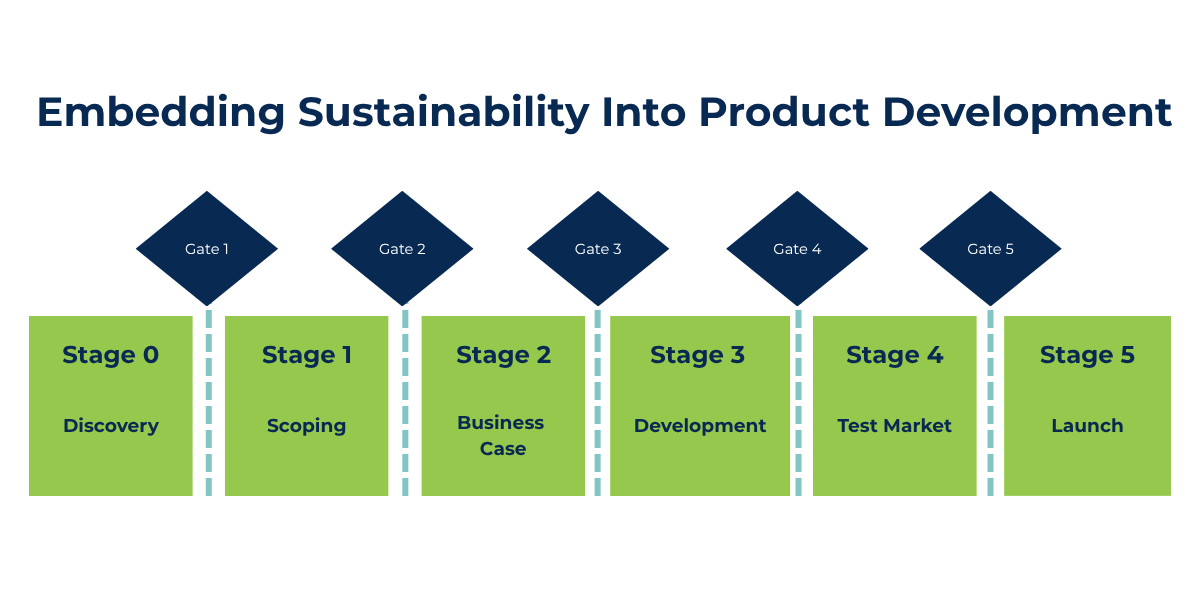
Sustainable Product Innovation (SPI) embeds sustainability into product development from the start. Rather than treating it as a separate initiative, SPI integrates sustainability considerations into each phase of the Stage-Gate® product development process. This helps organizations make smarter packaging and material decisions earlier, before costs, compliance risks, and packaging constraints are already locked in.
SPI ensures that key packaging design decisions are evaluated throughout each stage of product development by asking questions such as:
Does the product align with sustainability goals, EPR requirements, regulations, and customer expectations?
Are lower-impact materials or packaging designs viable?
Can these changes be implemented efficiently at scale while meeting performance requirements?
Can sustainability improvements be communicated credibly?
At Sustainable Solutions Corporation (SSC), our Sustainable Product Innovation approach integrates sustainability directly into the Stage-Gate product development process, the structured system most companies already use to bring products and packaging to market.
SSC works cross-functionally with teams across product development, engineering, procurement, sustainability, and marketing to deliver SPI workshops and customized sustainability scorecards tailored to each company's products and business goals.
These tools help companies establish sustainability criteria that can integrate directly into existing product development and Stage-Gate processes. SSC's SPI scorecards provide teams with a structured framework for evaluating packaging and material decisions across performance, cost, recyclability, environmental impact, material efficiency, and EPR considerations.
By embedding these criteria into product development workflows, organizations can standardize sustainability decision-making across product portfolios and make more consistent, data-driven packaging decisions.
Using Design for Environment Tools to Evaluate Packaging Trade-Offs
Life Cycle Assessments (LCAs) provide the data needed to identify packaging improvements that may lower costs under EPR fee structures. If LCAs identify opportunities for improvement, Design for Environment (DfE) tools help teams evaluate how those improvements can be implemented in practice.
DfE tools support engineers and designers in integrating sustainability into product design and packaging development. These tools are powered by LCA data, enabling informed decision-making in real time.
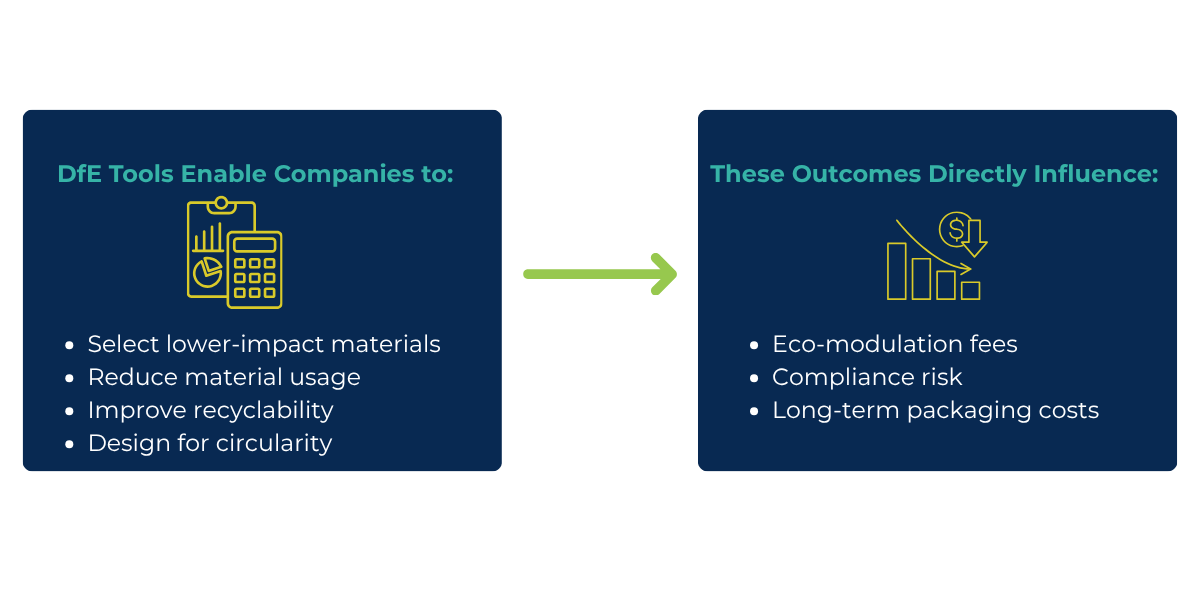
SSC's DfE tools are customizable to each company's product category and packaging portfolio, allowing teams to:
Compare multiple design scenarios side by side
Evaluate trade-offs across carbon, recyclability, cost, and performance
Identify opportunities to reduce material use
Select packaging that minimizes both environmental impact and EPR fees
How DfE Tools Support EPR Fee Reduction
Packaging decisions are rarely straightforward.
A material with excellent recyclability may increase packaging costs. A lower-cost material may result in higher EPR fees. Lightweighting may reduce material use but impact performance requirements. Increasing recycled content may support sustainability goals while creating sourcing challenges.
DfE tools help teams evaluate these trade-offs using data rather than assumptions.
This allows organizations to make packaging decisions based on a balanced view of performance, cost, environmental impacts, recyclability, and long-term regulatory considerations.
Moving from Compliance to Proactive Packaging Strategy
Companies can influence future EPR fees by reducing high-fee materials, increasing recyclability and circularity, optimizing material use through lightweighting, and incorporating recycled content into packaging.
However, determining which approach to take requires companies to look closely at their products, materials, packaging requirements, and lifecycle impacts. In many cases, the best option is not always the most obvious.
Data-driven tools like Sustainable Product Innovation and Design for Environment help companies evaluate these trade-offs and make informed packaging decisions that support compliance and long-term cost reduction.
EPR is changing how companies evaluate packaging decisions. Organizations that wait until compliance deadlines approach may find themselves facing higher fees and redesign costs. Those that integrate sustainability, lifecycle thinking, and packaging optimization into product development today will be better positioned to reduce costs and adapt to evolving regulations.
Frequently Asked Questions
What Tools Are Available for Developing Packaging That Complies with EPR Regulations?
Companies have several tools available to help evaluate packaging decisions and identify opportunities to reduce EPR fees while improving sustainability performance.
Life Cycle Assessments (LCAs) provide data on the environmental impacts of packaging throughout its lifecycle and help identify opportunities for material optimization.
Design for Environment (DfE) tools allow teams to compare packaging alternatives based on cost, performance, recyclability, environmental impact, and EPR considerations.
Sustainable Product Innovation (SPI) embeds sustainability and EPR considerations into the product development process, helping organizations evaluate packaging decisions earlier and avoid costly redesigns.
How Should Companies Redesign Packaging to Comply with EPR Regulations?
When redesigning packaging for EPR compliance, companies should evaluate more than just the initial cost of materials.
Key factors to consider include:
Recyclability and material recovery potential
Recycled content
Packaging weight and material efficiency
Product performance requirements
End-of-life outcomes
Compliance across multiple state EPR programs
Supply chain and operational considerations
Because packaging decisions often involve trade-offs between cost, performance, and sustainability, many organizations use Life Cycle Assessments (LCAs), Design for Environment (DfE) tools, and Sustainable Product Innovation (SPI) processes to evaluate alternatives and identify the most effective path forward.
These approaches help companies develop packaging strategies that not only support EPR compliance but also reduce long-term regulatory costs and improve packaging performance.
Meet the Expert

Tad Radzinski,
PE, SEP, LEED AP, SFP
Co-Founder & President
Tad Radzinski is a recognized sustainability expert and former EPA Waste Minimization National Expert with over 35 years of experience advising Fortune 500 companies. He is Co-founder and President of Sustainable Solutions Corporation, providing decarbonization consulting and training across industries, and Co-founder of GreenCircle Certified, which verifies sustainability claims for top brands like P&G, 3M, and Amazon.
Tad co-hosts the Tad Talks Sustainability podcast, simplifying complex topics and featuring major companies. He also helped develop Villanova University’s MS in Sustainable Engineering and taught there for 18 years, covering Life Cycle Assessment and Sustainable Buildings and Operations.
Stage-Gate® is a registered trademark in the United States of Stage-Gate International Inc. and in Canada and Europe of Robert G. Cooper.